
A Shaper Origin has been on the shop wish list since it came out nine years ago. It is a handheld CNC router that compensates for operator unsteadiness and precisely guides the bit on its programmed path to produce template shapes, joinery, and any other shape that a handheld router is capable of making. The Shaper uses machine vision to view a field of domino shapes to orient itself on the plane of the workpiece and Scalable Vector Graphic files to produce the desired shapes. The domino field is established with tape affixed to the work piece (making the scale of projects theoretically unlimited), or via durable templates and work fixturing accessories that permit accurate, repeatable setups even for curved pieces.
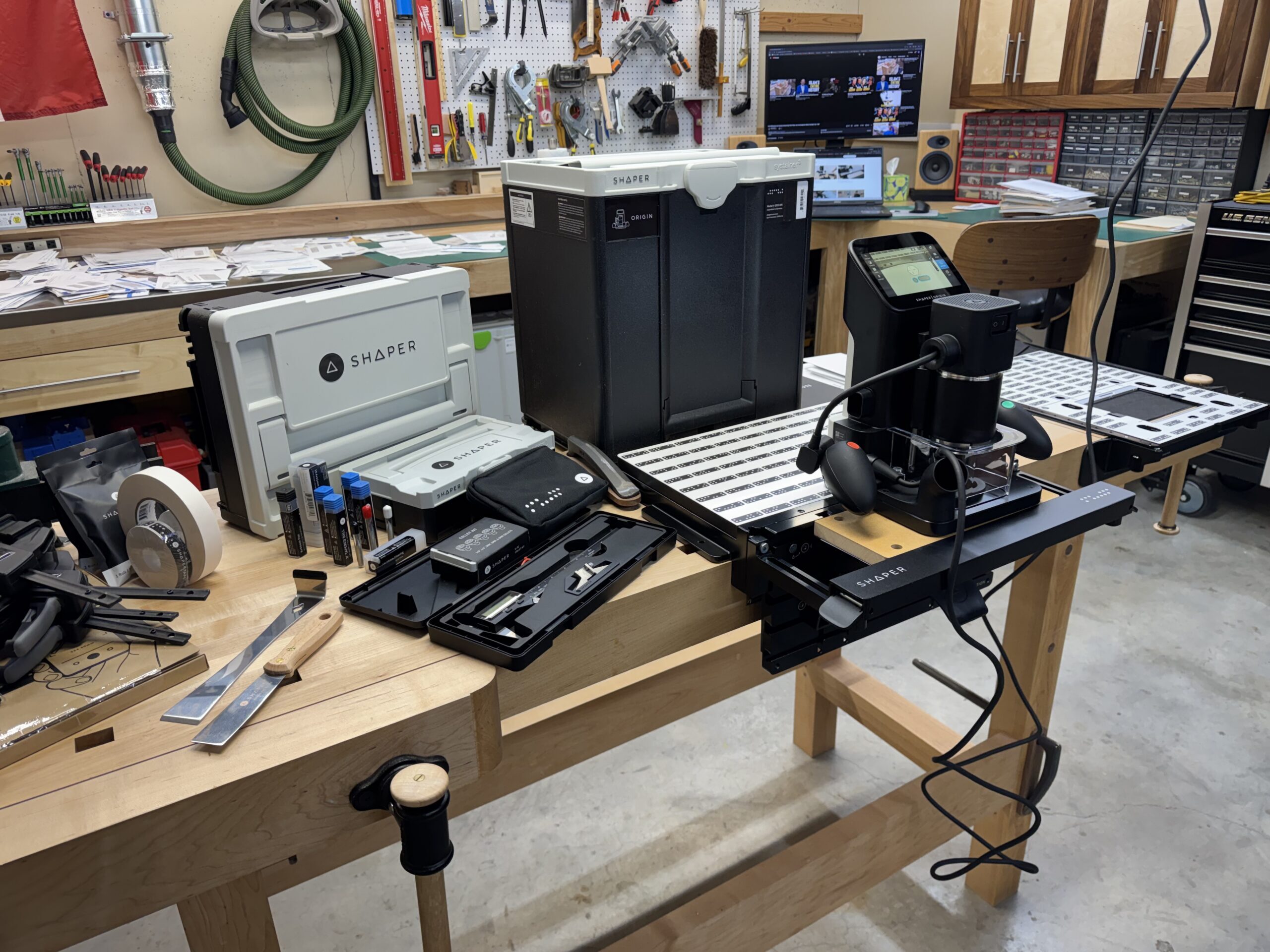
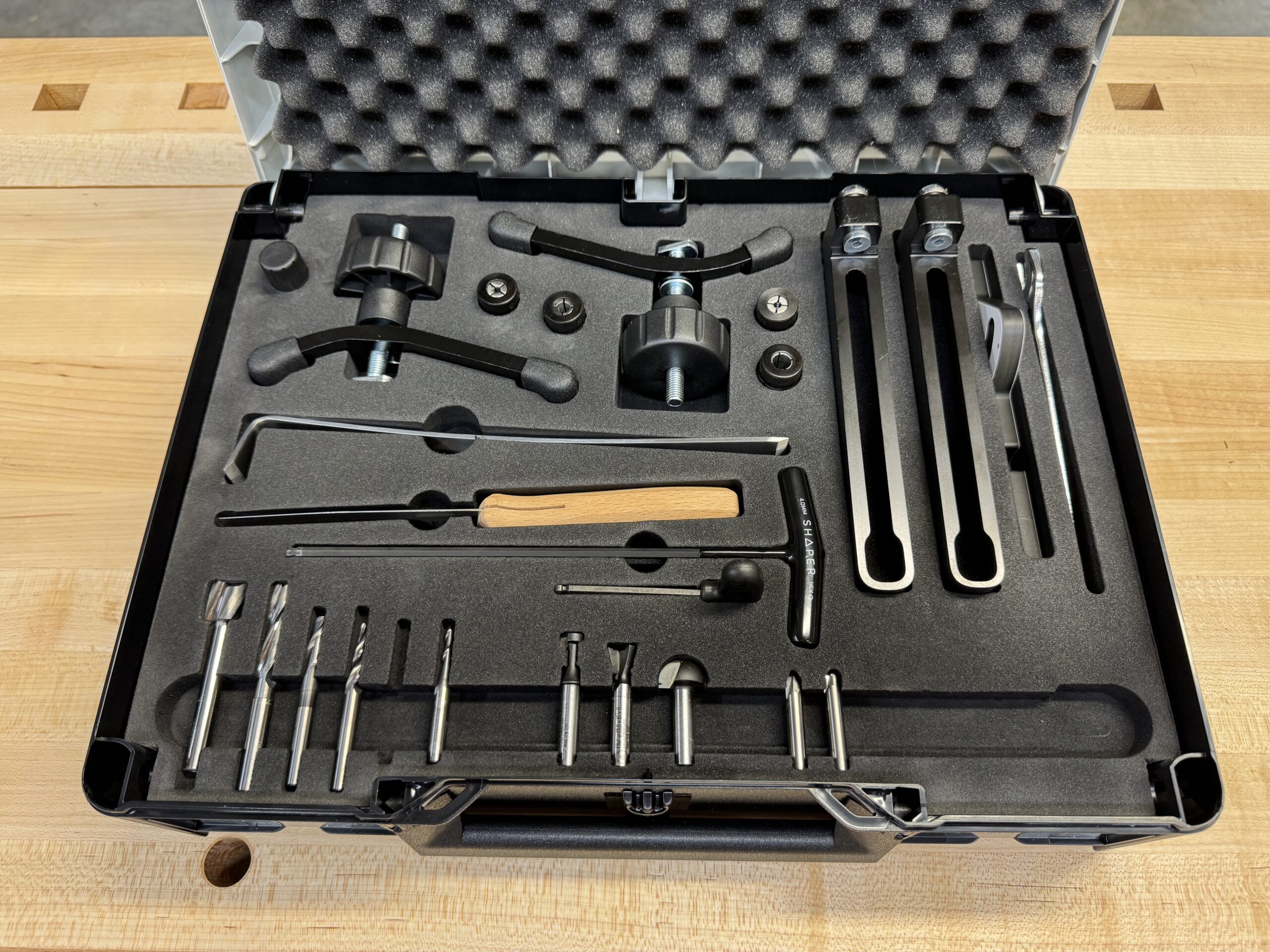
The first project was to mill out the foam in the free accessory Systainer that was provided with the order. This is a great first project for getting to know the software and the tool. Shaper makes the Systainer foam shape as well as accessory shapes available to load in Shaper Studio, a web-based basic CAD application that produces SVG files which are automatically synced to the tool in real time. Bluetooth connected calipers allow measurements to be instantly loaded into the tool. Pretty slick.
The learning curve is pretty manageable. With these tools it is a relatively simple matter to experiment with layouts, finalize a design, program cut depths, specify the correct bits, preview your results in CAD, and start cutting.
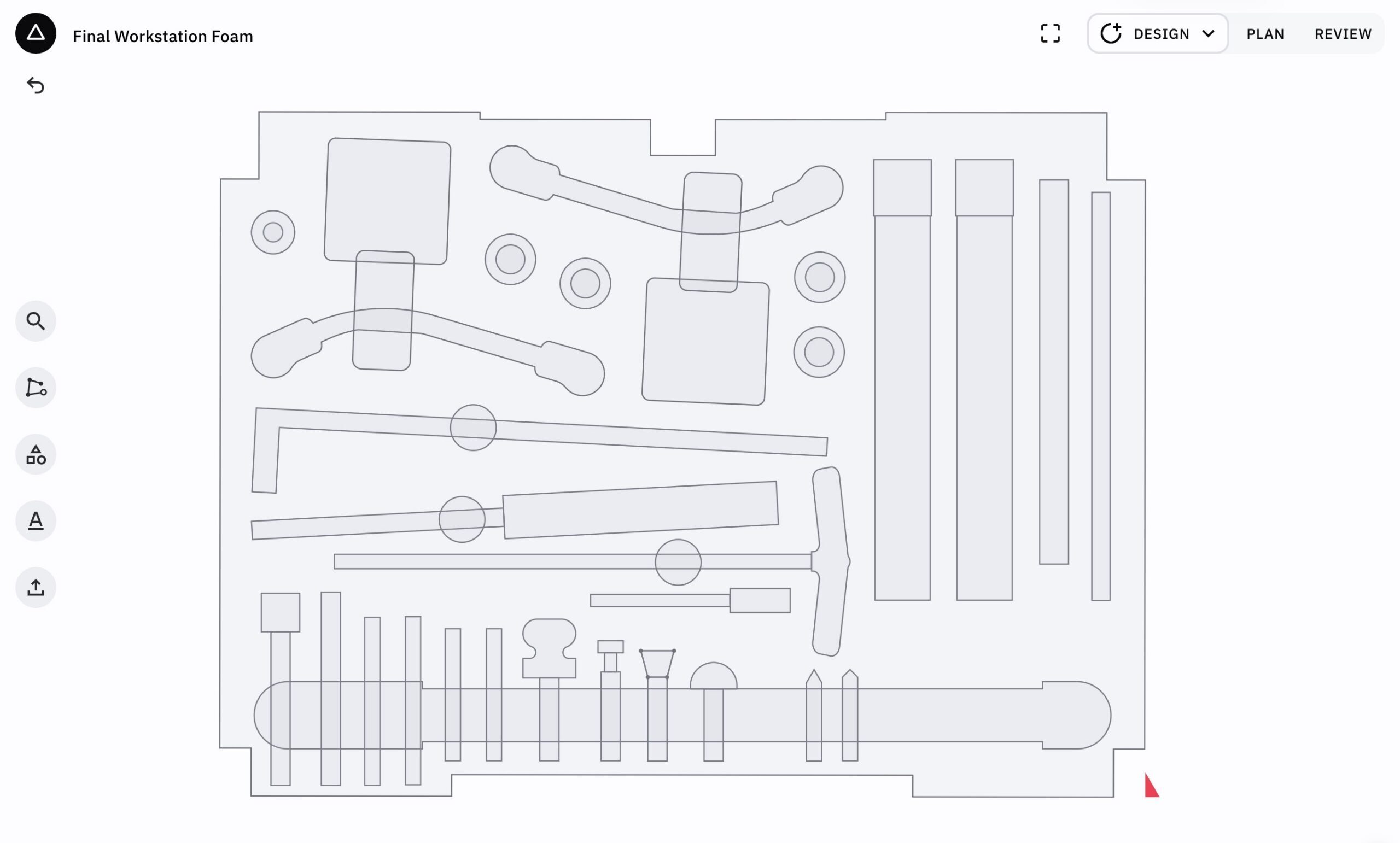
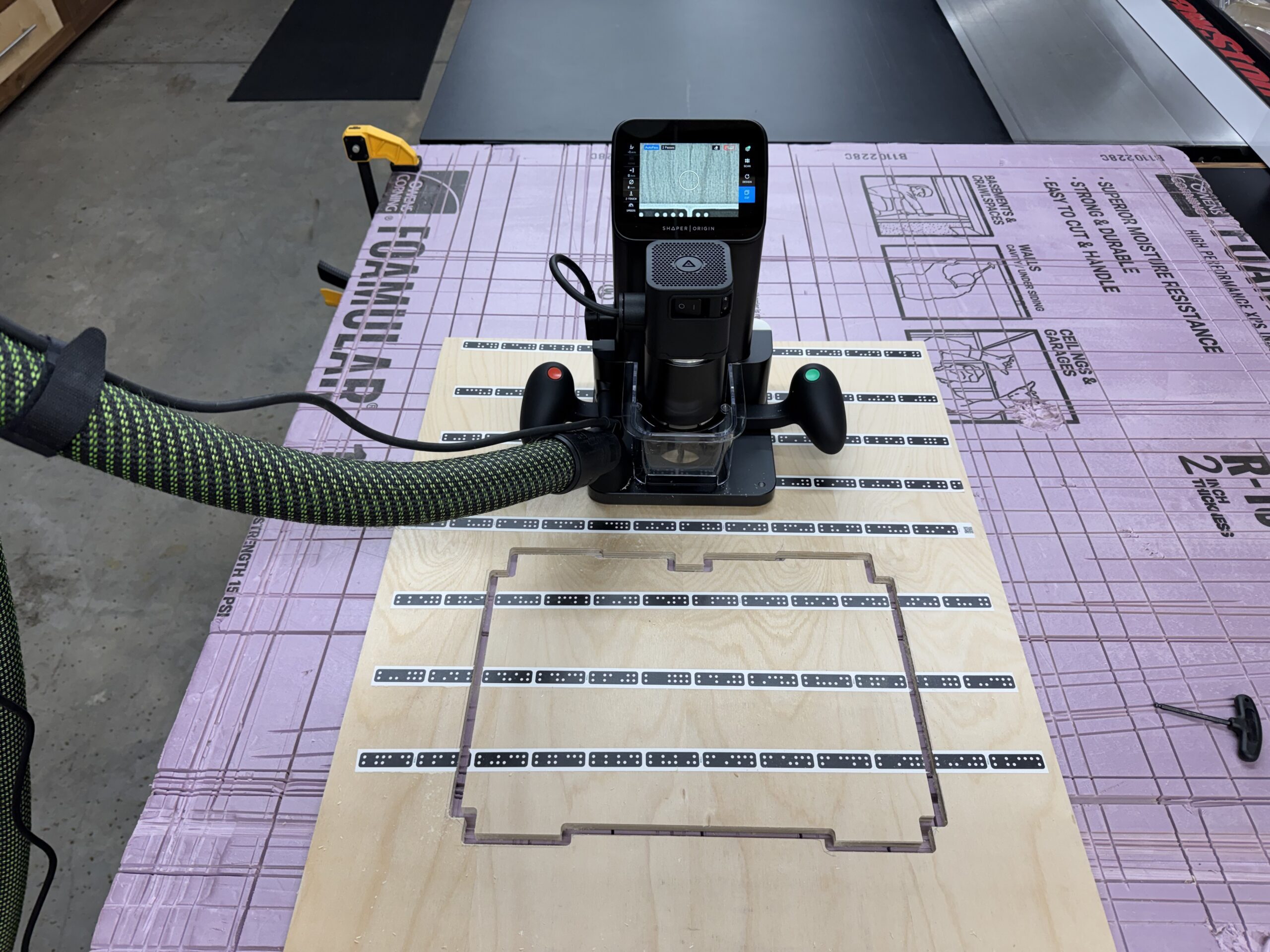
The first step is to lay tape out on a piece of 1/2″ ply, load in the foam insert outline, and mill out a perfectly fitting frame for the foam that holds it in a fixed position relative to the tape field, and keeps the tape field coplanar with the surface of the foam.
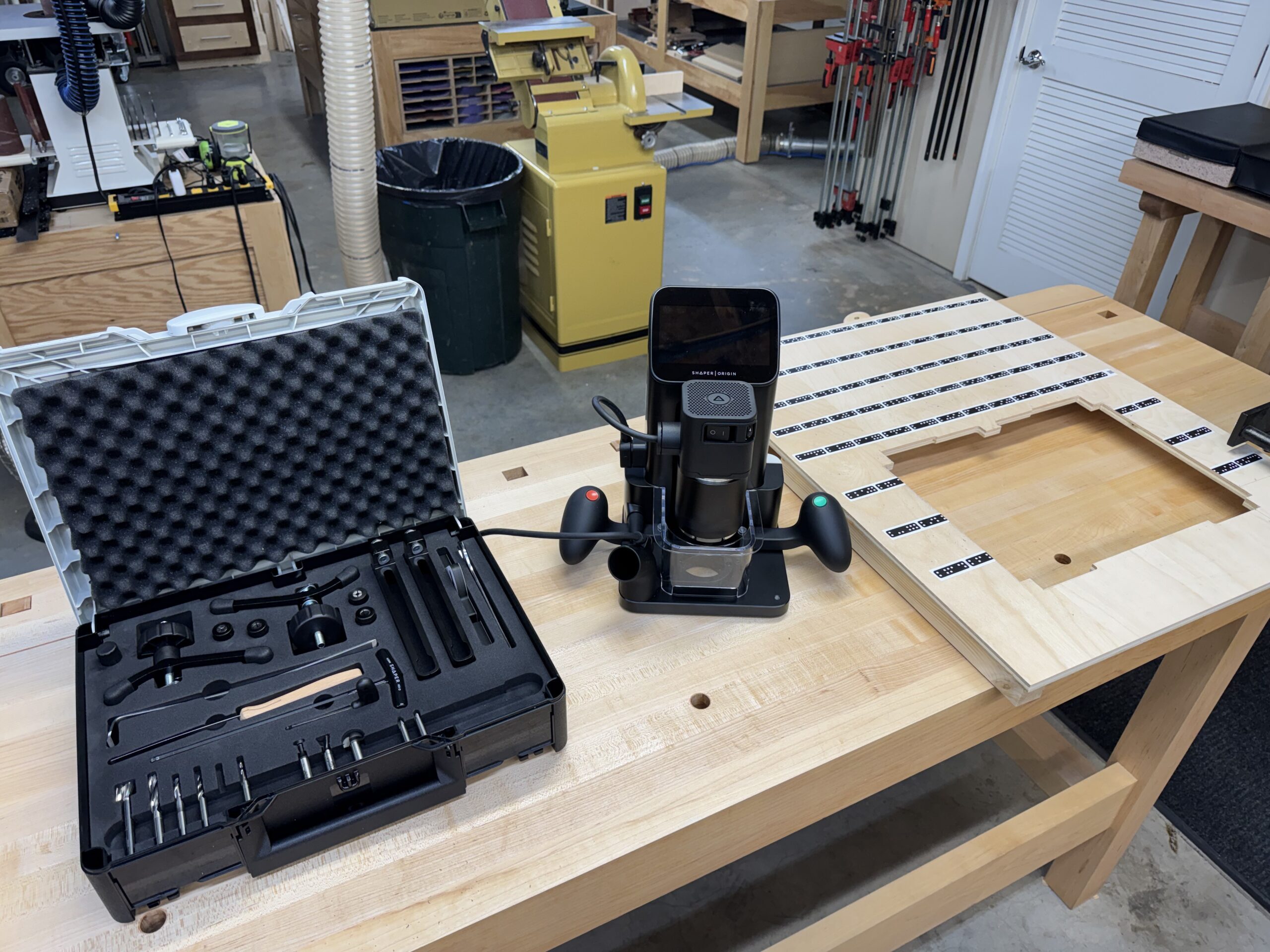
Spacer blocks are added to the bottom to make the surface of the template the same height as the foam insert.
With the foam fixed in the template, the pockets are milled perfectly by the Shaper. Incredible. CNC opens up a whole new world in the shop.
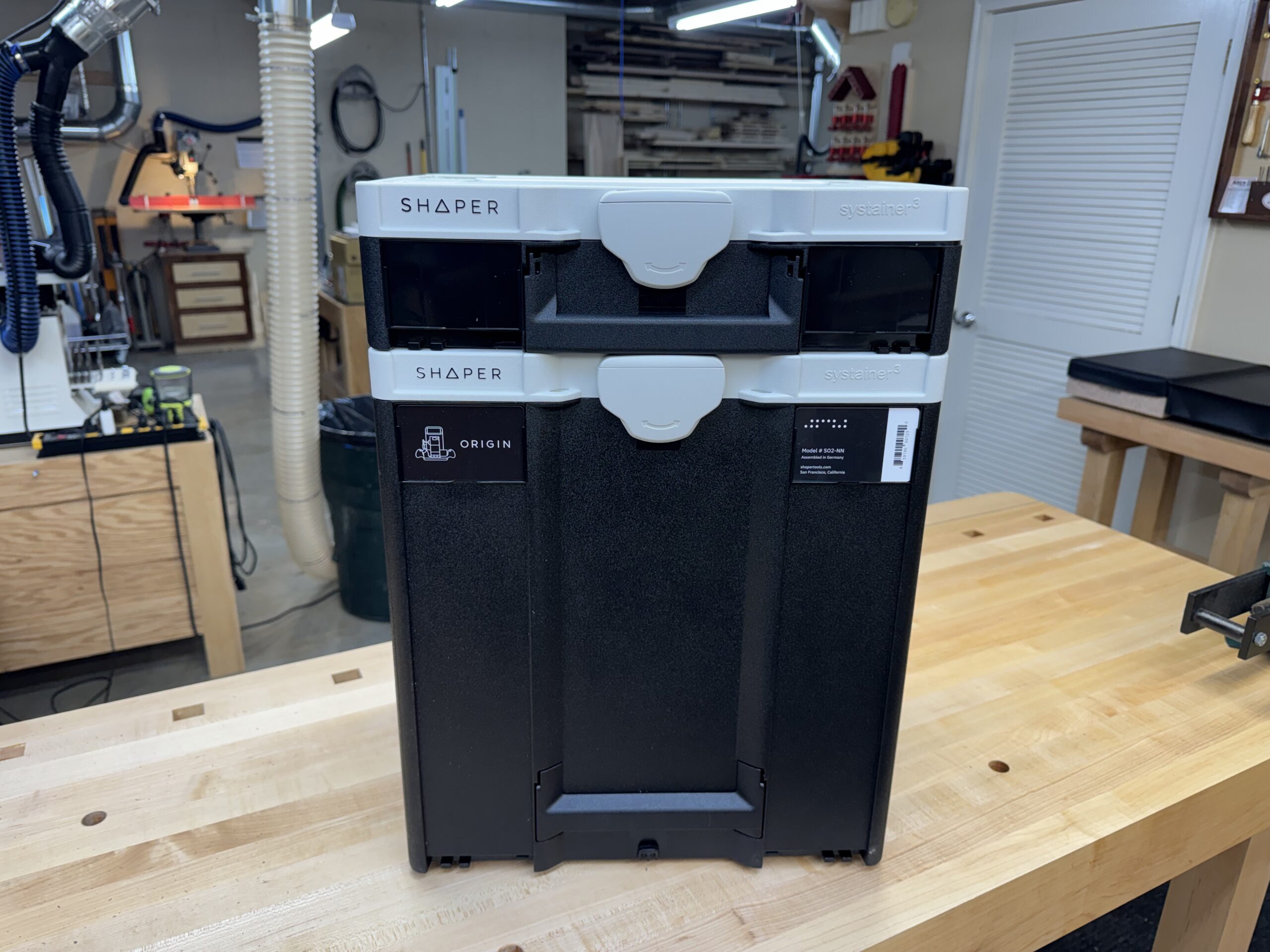
It is a very capable, well designed, and well built tool. It is manufactured by Festool in Germany, and they do a good job for the most part. The Shaper Studio CAD software is very basic and limited to two dimensional space, but it is exactly what the Shaper itself needs. Scaled Vector Graphic (SVG) files can be created and exported from more robust CAD applications like SketchUp and loaded onto the Shaper. Therefore, the user is free to do three-dimensional designing and visualization in other applications and relegate Studio to the execution phase of the process. Further, simpler shapes and operations can be created in Studio or on the tool itself without the use of a computer at all. This arrangement is very practical and perfectly adequate to get the results you want out of the tool. It is a good balance between intuitive simplicity and functionality.
The complaints that have developed so far are minor. Studio has a tendency to lose its server connection from time to time, which is annoying. However, your work is saved in real time, so nothing gets lost. You simply have to login again and you are right where you left off. Additionally, the custom foam insert for the Shaper accessory Systainer is unobtainable. If a mistake is made, or there is a need to reconfigure, you are out of luck, which is pretty crazy.
The other issue was with the Work Station. Out of the box, the tape field table was not coplanar with the work fixture. It was both high and slightly angled out of plane. However, some experimentation with the shims that had been installed at the factory (three were removed entirely and their positions were changed) resolved this issue.
Overall, it is a pricey, slick, and very clever tool. It feels like a collaboration between Festool and Apple. Although the price of admission is high, it is arguably more useful and capable for the kind of work that a hobbyist or furniture maker does than a gantry-style 4’x8′ CNC which takes up an enormous amount of space and is more costly. Sure, it won’t flatten slabs or automate z-axis shaping, but these are not operations I have a need to perform on a regular basis. There are shop-built power tool (as well as hand tool) alternatives for flattening large pieces. The real super power of the Shaper Origin system is that it will accurately fixture and cut joinery on curved work pieces, which is invaluable and something a gantry-style machine cannot do. Further, it will produce large (full sheet) pattern routing templates and intricately shaped flat parts, which is mainly what I would use a gantry CNC for anyway.
In summary, my first impression is that the Shaper Origin will allow me to do things quickly and accurately that would otherwise be difficult, laborious, time-consuming and less accurate and repeatable. It will also encourage creativity and refinement of designs because making alterations and producing new templates is easy, accurate and fast. It’s a wonderful invention.